Brachidger
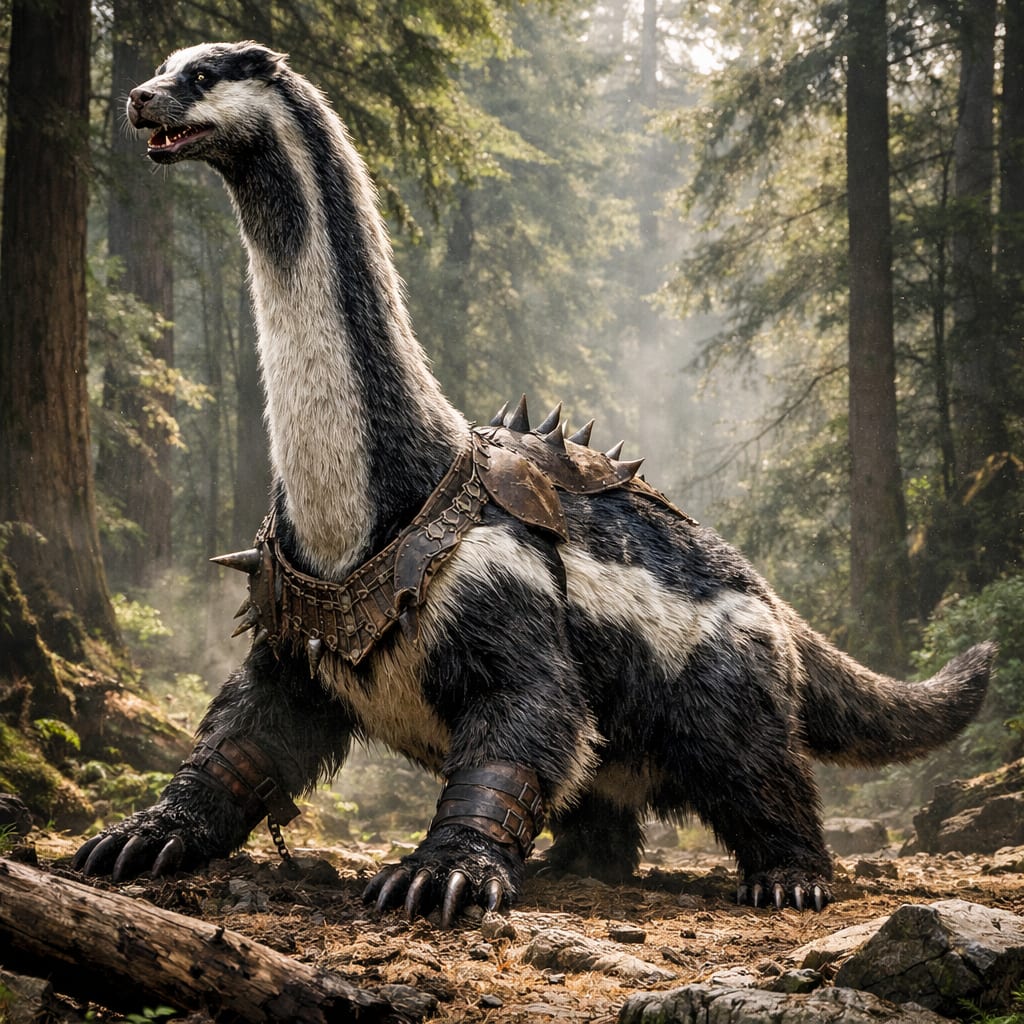
A hybrid of Brachiosaurus + Badger
- Habitat
- The Brachidger thrives in dense, temperate forests and open woodlands where it can easily access both foliage and burrows. It prefers areas with abundant trees for grazing and ample ground cover for shelter.
- Diet
- As an omnivore, the Brachidger primarily feeds on leaves, fruits, and flowers from tall trees, similar to its Brachiosaurus lineage. However, it also forages for insects, small mammals, and roots, reflecting its badger ancestry.
The story of Brachidger
The Brachidger is a remarkable hybrid creature combining the towering stature of the Brachiosaurus with the tenacious spirit of a badger. Standing at an impressive 15 feet tall, it possesses a long neck that allows it to browse on treetops, while its stout, muscular body resembles that of a badger, covered in coarse, striped fur. Its forelimbs are robust and equipped with sharp claws, ideal for digging and foraging, while its tail is long and powerful, aiding in balance and communication.
Special abilities
Tremor Charge
The Brachidger stomps the ground with its massive feet, generating a localized tremor that can knock opponents off balance.
From the Brachiosaurus
Real-world basis: The force exerted by large terrestrial animals can create seismic waves that affect the environment.
Claw Slash
With its sharp claws, the Brachidger delivers a swift and powerful slash, inflicting significant damage on its target.
From the Badger
Real-world basis: The badger’s claws are adapted for digging and can be effectively used for defense and offense.
Natural Camouflage
The Brachidger can blend into its forest surroundings, making it harder for predators to spot it.
From the Badger
Real-world basis: Many animals use coloration and patterns to evade detection in their natural habitat.
Neck Shield
Utilizing its long neck, the Brachidger can shield itself from attacks by maneuvering its head and body to deflect incoming strikes.
From the Brachiosaurus
Real-world basis: The ability to utilize body parts as shields is seen in various large herbivores.